Power System Reliability: Understanding SAIDI, SAIFI, and CAIDI
What SAIDI, SAIFI, and CAIDI actually tell you as a working guide to grid performance and how to calculate them.

Omar Sher
What Does a Reliable Power System Actually Mean?
A reliable power system is one that delivers power consistently, with interruptions that are infrequent and brief. In technical terms, reliability is defined as the probability that a system will perform its intended function without failure over a specified period under defined operating conditions.
For an electric utility, this means maintaining power supply to all customers within its service area at or above agreed service levels. Regulatory authorities increasingly require utilities to measure and report reliability performance using standardized indices, and customers expect uninterrupted supply as a baseline.
As grids become more complex through the addition of EVs, battery storage, renewable generation, distributed resources, and smart devices, the challenge of maintaining reliability increases. Standardized measurement frameworks become more critical, not less.
The Three Core Reliability Indices Explained
There are multiple reliability indices in use globally, including MTBF (Mean Time Between Failure), MTTR (Mean Time To Repair), LOLP (Loss of Load Probability), and ENS (Energy Not Supplied). For practical grid management, the three most widely used and interpretable indices are SAIDI, SAIFI, and CAIDI.
SAIDI | Total duration of interruptions across all customers ÷ Total number of customers served |
SAIDI (System Average Interruption Duration Index) measures the average total duration of interruptions experienced per customer over a given period. A lower SAIDI score indicates shorter total outage duration across the customer base.
SAIFI | Total number of customer interruptions ÷ Total number of customers served |
SAIFI (System Average Interruption Frequency Index) measures the average number of interruptions experienced per customer over a given period. A lower SAIFI score indicates fewer interruptions per customer. For reference, the IEEE 1366 median SAIFI benchmark for North American utilities is 1.10 interruptions per customer per year.
CAIDI | Total duration of interruptions ÷ Total number of customer interruptions (or: SAIDI ÷ SAIFI) |
CAIDI (Customer Average Interruption Duration Index) measures the average duration of each interruption experienced by customers who are actually interrupted. It is a measure of restoration speed.
Worked Example: Calculating SAIDI, SAIFI, and CAIDI
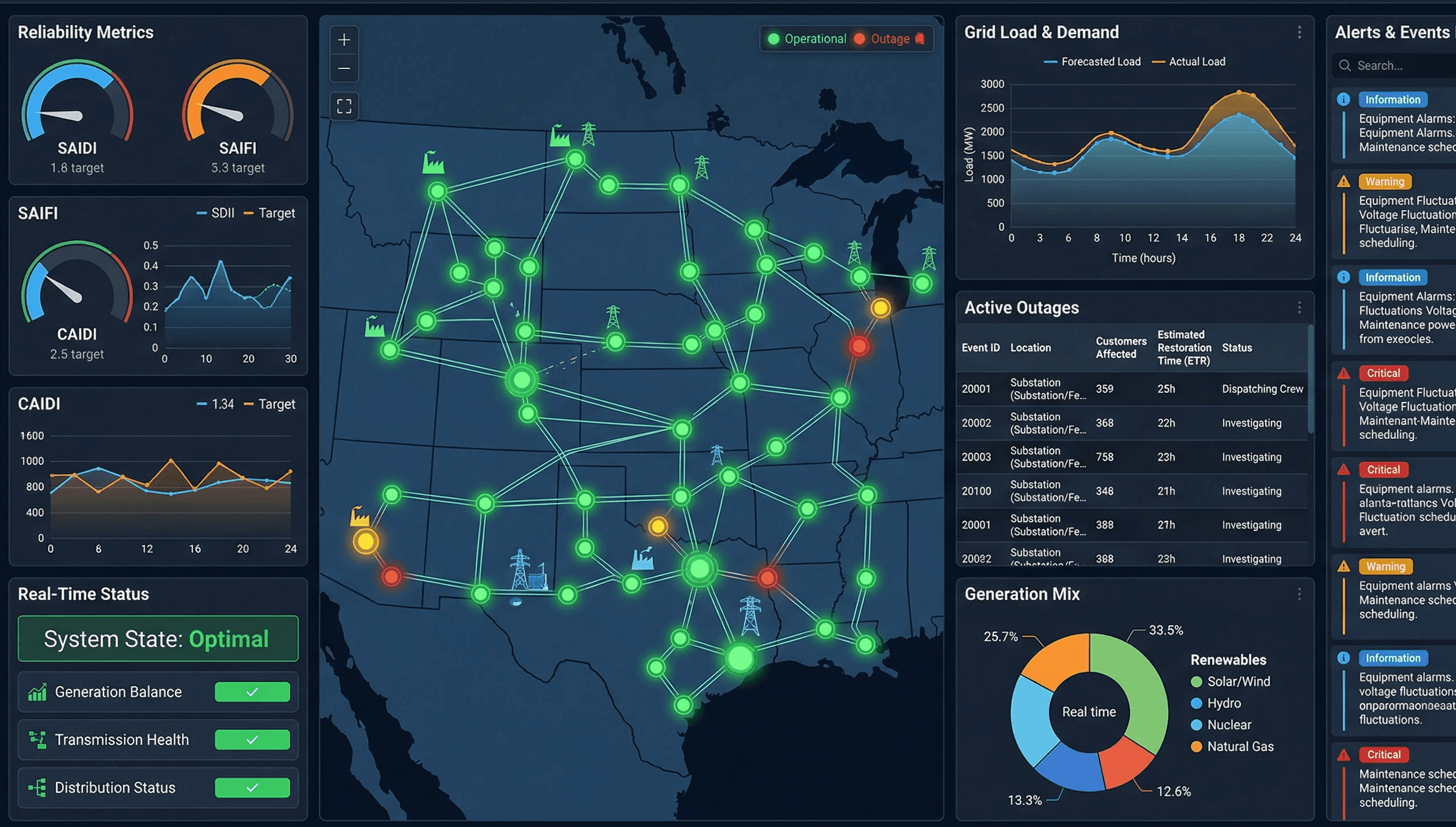
Assume an electric utility with 10,000 total customers. On a given day, feeder lines F1, F2, F3, and F4 experienced outages with the following aggregate data:
Data Point | Value |
|---|---|
Total customer hours curtailed (all feeders) | 804.17 hours |
Total customers interrupted | 2,600 |
Total customers served | 10,000 |
SAIDI Calculation
Convert customer hours curtailed to minutes: 804.17 hours x 60 = 48,250.2 minutes.
SAIDI = 48,250.2 minutes ÷ 10,000 customers = 4.825 minutes per customer.
SAIFI Calculation
SAIFI = 2,600 interrupted customers ÷ 10,000 total customers = 0.26 interruptions per customer on that day.
For comparison: the IEEE(Institute of Electrical and Electronics Engineers) 1366-1998 median SAIFI for North American utilities is 1.10 interruptions per customer per year. Note that this worked example measures a single day, not an annual figure.
CAIDI Calculation
CAIDI = 48,250.2 minutes ÷ 2,600 interrupted customers = 18.55 minutes per interruption per customer.
Verification: SAIDI ÷ CAIDI = 4.825 ÷ 18.55 = 0.26, which confirms the SAIFI result.
Index | Score |
|---|---|
SAIDI | 4.825 minutes per customer |
SAIFI | 0.26 interruptions per customer |
CAIDI | 18.55 minutes per interruption |
These three numbers give an operator a clear and defensible starting point for maintenance investment decisions, regulatory reporting, and benchmarking against peer utilities. When broken down at the feeder level, they quickly surface which parts of the network are underperforming and where capital should be directed.