Five Practical Solutions for Managing Distribution Grid Stability
What grid operators, infrastructure founders, and funders actually do when the distribution network starts failing and what it costs to fix it.

Omar Sher

Five Practical Solutions for Managing Distribution Grid Stability
Depending on the nature of the problem, technical complexity, and the operator's available toolset, there are a number of effective remedies at different levels of investment and sophistication.
1. Train Dedicated Teams on Maintenance, Installation, and Grid Analysis
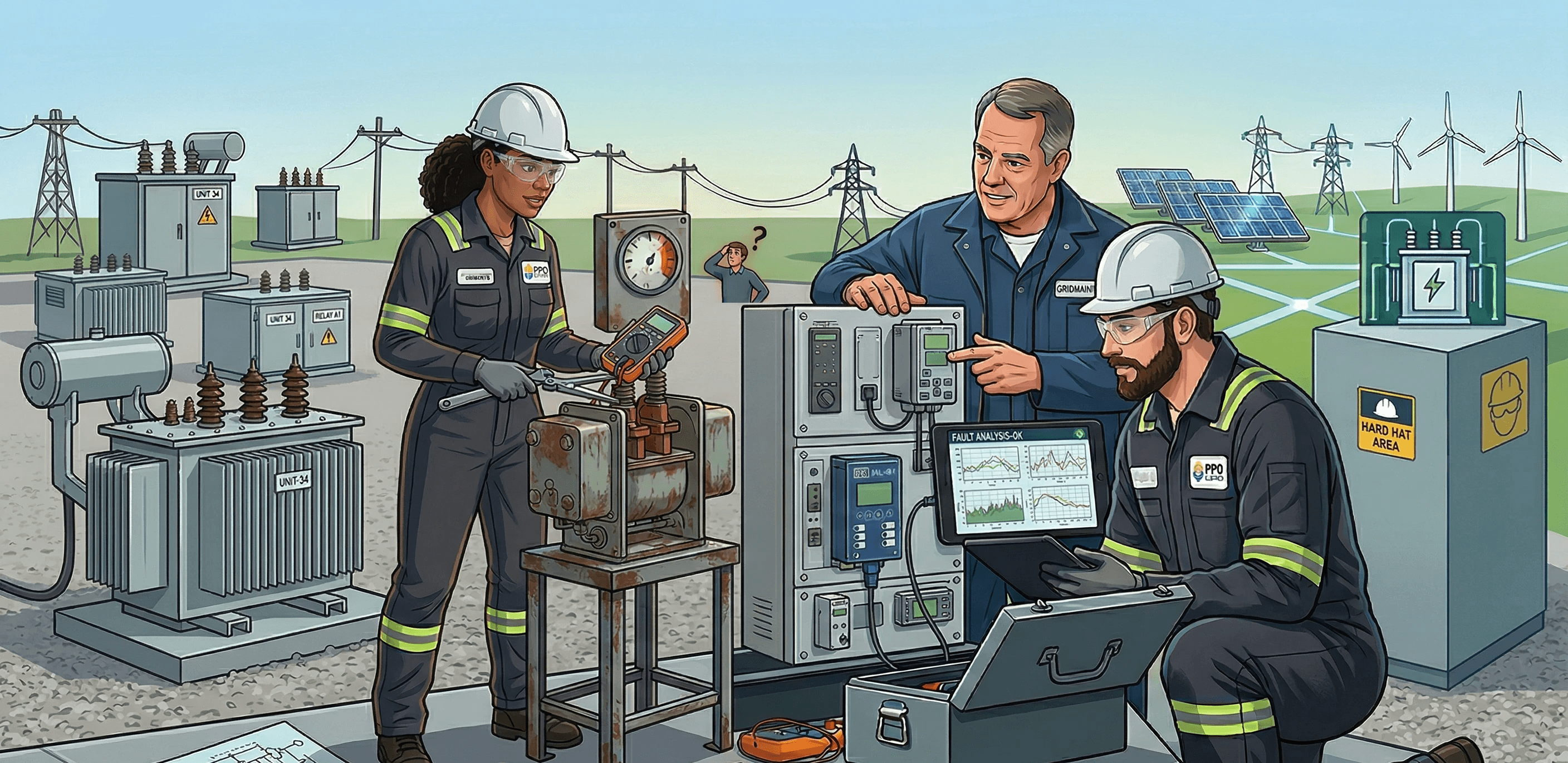
Effective grid management begins with people. Assigning trained personnel to maintenance, installation, and fault analysis is foundational. In markets where regulatory mandates around routine maintenance are still developing, the absence of trained teams creates compounding risk: faults go undetected longer, safety incidents increase, and grid assets deteriorate faster than necessary.
Basic but targeted training programs deliver outsized returns. At minimum, maintenance teams should understand the function and failure modes of key distribution components including surge arresters, string insulators, load-break switches, and auto-reclosers. They should be able to visually inspect for signs of deterioration such as burn marks, insulation damage, and clearance violations from trees or structures. A foundational understanding of asset lifecycle assessment, combined with consistent safety protocols, can prevent the majority of both human injury incidents and accelerated equipment failures.
2. Identify and Monitor Voltage Fluctuation Points Across the System
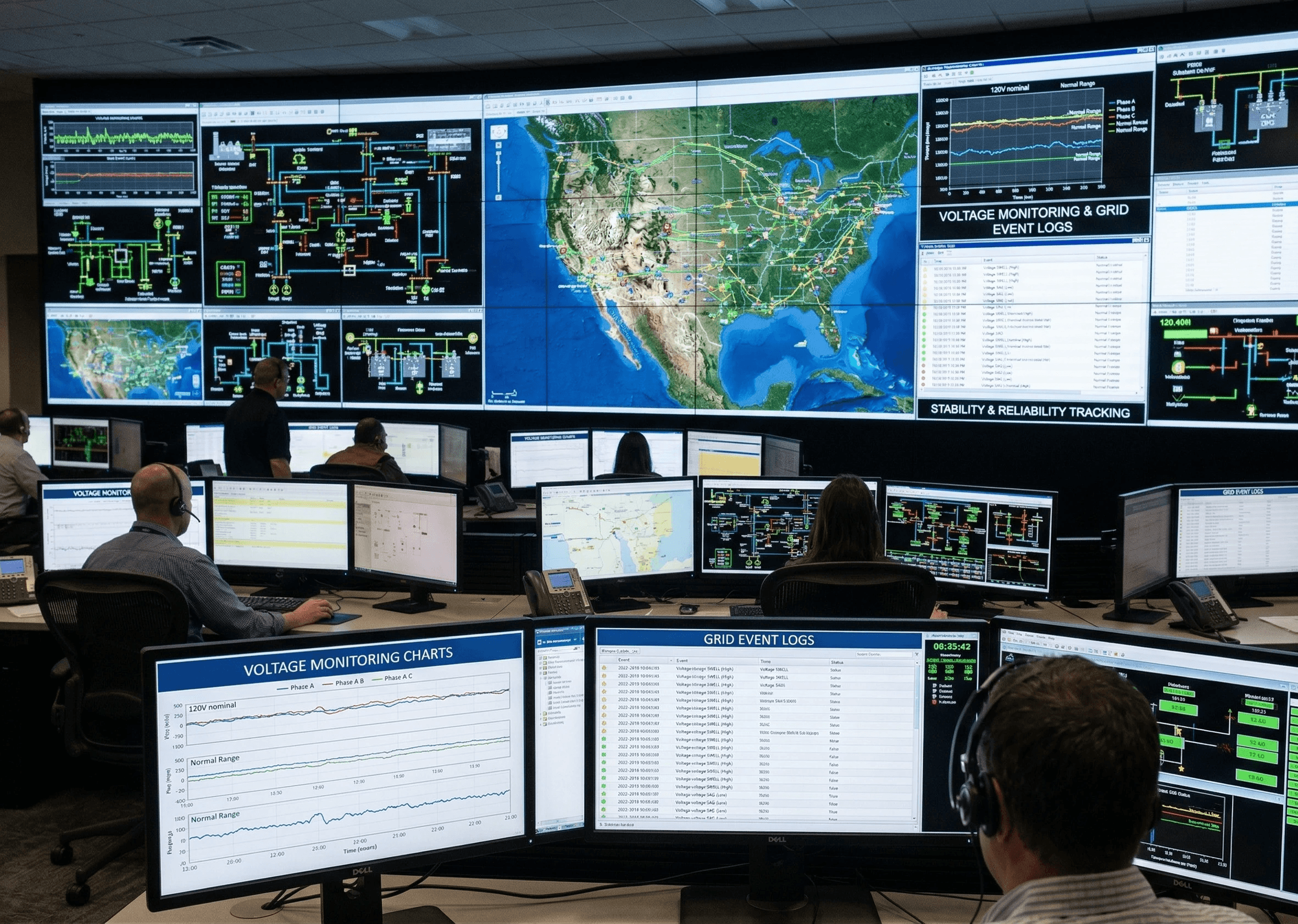
Voltage fluctuations, whether from overload, under-load, or non-compliant component specifications, degrade power quality and accelerate the deterioration of grid assets and end-user equipment. Identifying where these fluctuations occur and what is causing them is a prerequisite for resolving them.
Practical starting points include reviewing event logs from auto-reclosers and meters, with a focus on peak load readings across daily, weekly, and monthly intervals. This gives operators visibility into patterns of high and low load periods and supports better capacity planning. If peak loads are breached briefly and infrequently, the issue may be negligible. If peak loads are sustained or worsening over time, the data justifies investment in additional infrastructure.
It is also worth noting that voltage fluctuations are not always demand-driven. Non-compliant cable specifications are a common and under appreciated contributor. IEC standards 60228 and 61089 specify nominal cross-sections for insulated conductors at defined current ratings. Cables that fall outside these specifications can introduce over-voltage conditions that damage equipment and create safety risks.
3. Consider Load Sharing Through a Closed Loop or New Distribution Line
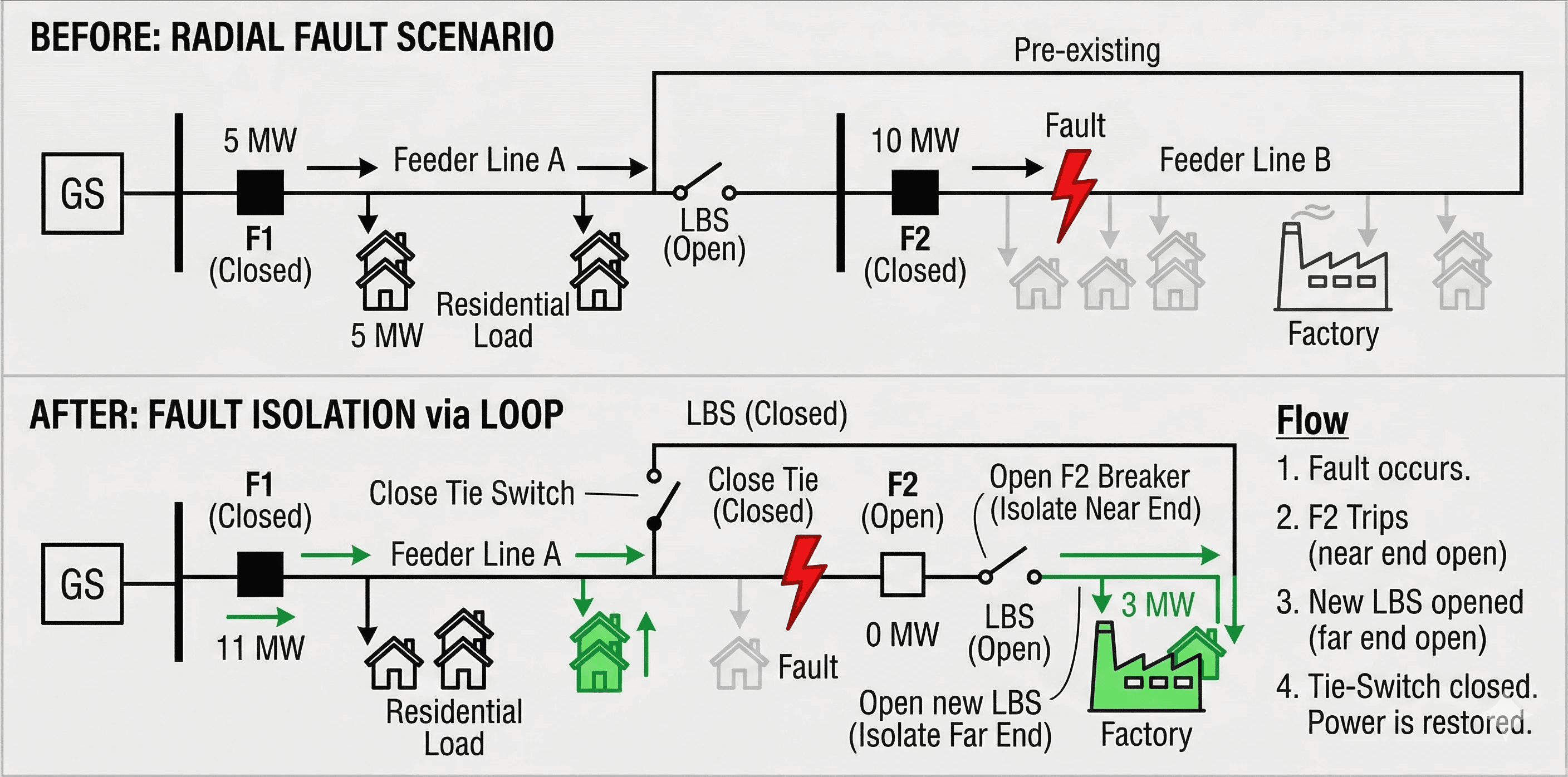
When a single feeder line is carrying disproportionate load, particularly where a large industrial or commercial consumer is grid-connected, load sharing offers an effective structural remedy.
One practical approach is to construct an additional distribution line and configure it in a closed loop with existing feeders. In this configuration, if a fault occurs on the overloaded line, its load-break switch opens to isolate the affected section while the load-break switch on the new line closes to redirect power, maintaining supply to critical customers.
As an illustration: if Feeder 1 carries 5 MW and Feeder 2 carries 10 MW including a 3 MW factory load, the imbalance places Feeder 2 under chronic strain and creates fault risk for all connected customers. Introducing a third line in a closed loop configuration rebalances the system so that each feeder is carrying a comparable and sustainable load, eliminating the fault conditions and improving reliability for all customers on that section of the grid. After construction, the new line also provides additional monitoring points where meters, fuse-savers, and auto-reclosers can be installed to extend data collection further into the network.
4. Track Feeder Lines With Recurring Faults
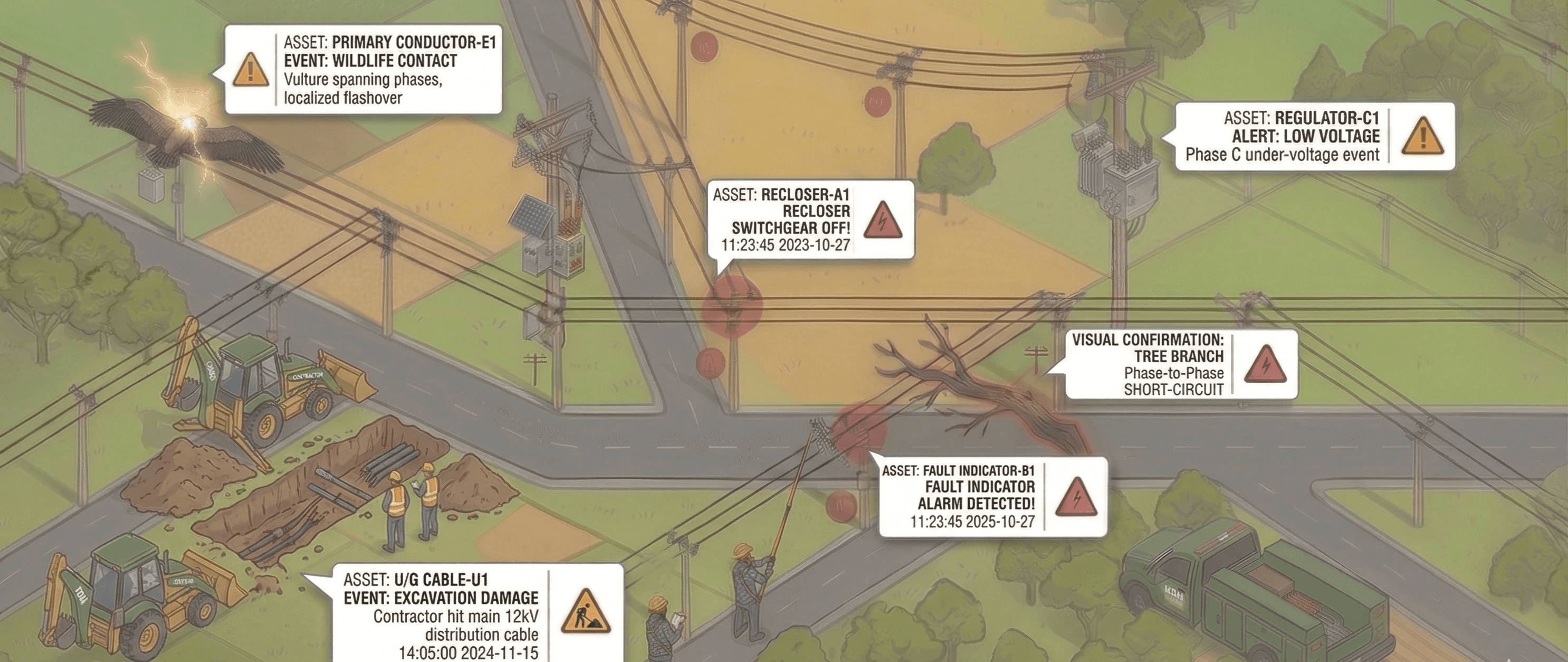
Recurring faults on a specific feeder are not random. They indicate an underlying condition that, if identified and addressed, can eliminate a disproportionate share of outage events.
A practical monitoring method is to track auto-recloser trip events: which device is tripping, how frequently, and on which phase. Auto-reclosers have a defined lockout sequence, typically four trip cycles before locking out. If a device reaches lockout repeatedly, it signals one of several underlying conditions: vegetation interference, a broken or degraded cable, insufficient insulation, dielectric failure, or a flash-over event, the last of which presents serious risk to human life and grid assets.
Recurring trips driven by severe weather, particularly lightning storms, point to a different category of intervention. In these cases, solutions such as installing a SWER (Single Wire Earth Return) line or additional surge protection equipment may be appropriate to reduce flash-over risk and protect the surrounding infrastructure.
Systematic fault tracking does not require advanced technology to begin. A structured log of auto-recloser events, reviewed regularly, is sufficient to identify patterns and build the evidence base for targeted investment decisions.
5. Invest in Modern Equipment, Remote Controls, and SCADA or ADMS Platforms

The power grid is, in many parts of the world, operating on infrastructure that is decades old. Some circuit breakers in North American systems have exceeded 50 years of operational life. Legacy SCADA systems have existed in the energy industry since the 1960s. The technology gap between what is deployed and what is now available is significant.
Modernizing does not always mean replacing everything at once. IoT-enabled devices can be layered onto existing commissioned equipment, including auto-reclosers, meters, load-break switches, and sectionalizers, to enable remote monitoring and data transmission without a complete infrastructure overhaul. This approach bridges the gap between legacy assets and modern management capability in a cost-effective and operationally realistic way.
Where full SCADA or ADMS implementation is feasible, the operational benefits are substantial: real-time system visibility, remote control of grid switching operations, automated fault detection and isolation, demand forecasting, and AI-assisted decision support. These capabilities reduce outage duration, lower operational costs, extend asset life, and enable proactive grid management that reactive, manual processes cannot match.
The Smart Grid Imperative: Data, Automation, and What Comes Next
After walking through the fundamentals of distribution grid management, one conclusion is clear: data is at the center of all of it. Whether an operator is working with legacy equipment and limited budgets or deploying the latest in grid automation technology, the quality of decisions they can make is bounded by the quality and timeliness of the data available to them.
SCADA systems, EMS (Energy Management Systems), and ADMS platforms are the enabling infrastructure for a smarter grid: one that collects, processes, and visualizes data across the entire distribution network and allows operators to act on it in real time. When combined with remote control capabilities, DER integration, and AI-assisted forecasting, these platforms represent the path from reactive fault management to proactive, resilient grid operation.
The smart grid is not a single technology. It is an operating philosophy: one that places data, automation, and continuous improvement at the center of how electricity is generated, distributed, and consumed. Getting the basics right, as covered in this article, is the prerequisite for getting there.