How a Seed-Stage Agentic AI SaaS Platform Navigated Carbon Market Headwinds and Reached Institutional-Grade Investment Readiness
A case study in seed stage capital raising, sustainability investment readiness, SaaS financial modeling, climate tech funding strategy, and institutionalization of an opportunity in a shifting regulatory environment.
Overview
Founder Stage & Sector | Seed, B2B SaaS, Agentic AI, Sustainability |
Core Offering | An AI-powered SaaS platform for measuring, managing, and monetizing sustainability, with real-time dashboards, multi-jurisdictional compliance reporting, and AI-driven transition planning |
Engagement term | Q2 2025 - Q3 2025 |
Period of Performance | 6 months |
Focus Area | Capital Raise, Golden Egg Check, Valuation Analysis, Advisory, Investor Relations, Data Room |
Challenge
The founding team brought rare depth to this engagement: 75+ years of combined experience across real estate, finance, ESG, and carbon reporting, with proven execution, meaningful personal capital invested, and seasoned board leadership across energy and asset management. Their platform had already demonstrated strong monetization across compliance, carbon emissions, and tax angles, creating measurable strategic value for the organizations they served.
The capital raising target was a $3.5M SAFE note to accelerate toward a Series A or significant capital event within 24 months, with funds earmarked to scale global operations. Despite strong momentum, several gaps hindered progress: revenue had not yet reached the $50K-$100K MRR benchmarks expected for a round of this size, NRR data was absent, financial models did not link milestones to use of funds, and a high loss-to-win ratio signaled the need for a more repeatable sales process. The team was remotely dispersed and stretched thin, with capital raising infrastructure needing to be built from scratch.
Then came the One Big Beautiful Bill Act, signed July 4th 2025, which reversed investor sentiment toward ESG, sustainability, and carbon markets almost overnight, forcing a significant recalibration of the capital raising strategy.

Our Approach
The strategic focus of this engagement was to institutionalize the investment narrative and rigorously address operational gaps, transitioning the opportunity from a venture-led startup to a metrics-driven, institutional-grade seed-stage platform before bringing it to market.
Investment Readiness Assessment:
A comprehensive audit across 10 key dimensions, including product, team, and financials, established a baseline for investor attractiveness and informed narrative refinement against live market conditions.Sales & GTM Strategy Development:
A documented GTM strategy was developed to support the investment ask, outlining Ideal Customer Profiles, a sales team scaling plan, and clear visibility on unit economics, profitability, and financial viability. Empirical insights from the founding team were leveraged to optimize the RevOps strategy for this opportunity.SaaS Financial Modeling & Performance Tracking:
Financial projections, cash-flow forecasts, KPIs, and business development activities were built out collaboratively to establish a clear path to profitability and surface runway considerations critical to both capital and growth planning.Institutional-Grade Data Room Curation:
Essential legal, technical, and financial documents were organized into a structured, audit-ready investor data room to streamline due diligence and minimize friction during institutional review.Capital Raising Outreach & Campaign Management:
Over 370 investors were segmented and targeted for outreach across warm and cold networks, tracked from first contact through to GP, VC and principal meetings with institutional and seed-stage investors. Engagement was documented by supporting VDR analytics which also brought insights on investor signalling, focus areas and supported pitch-preparation.
Results
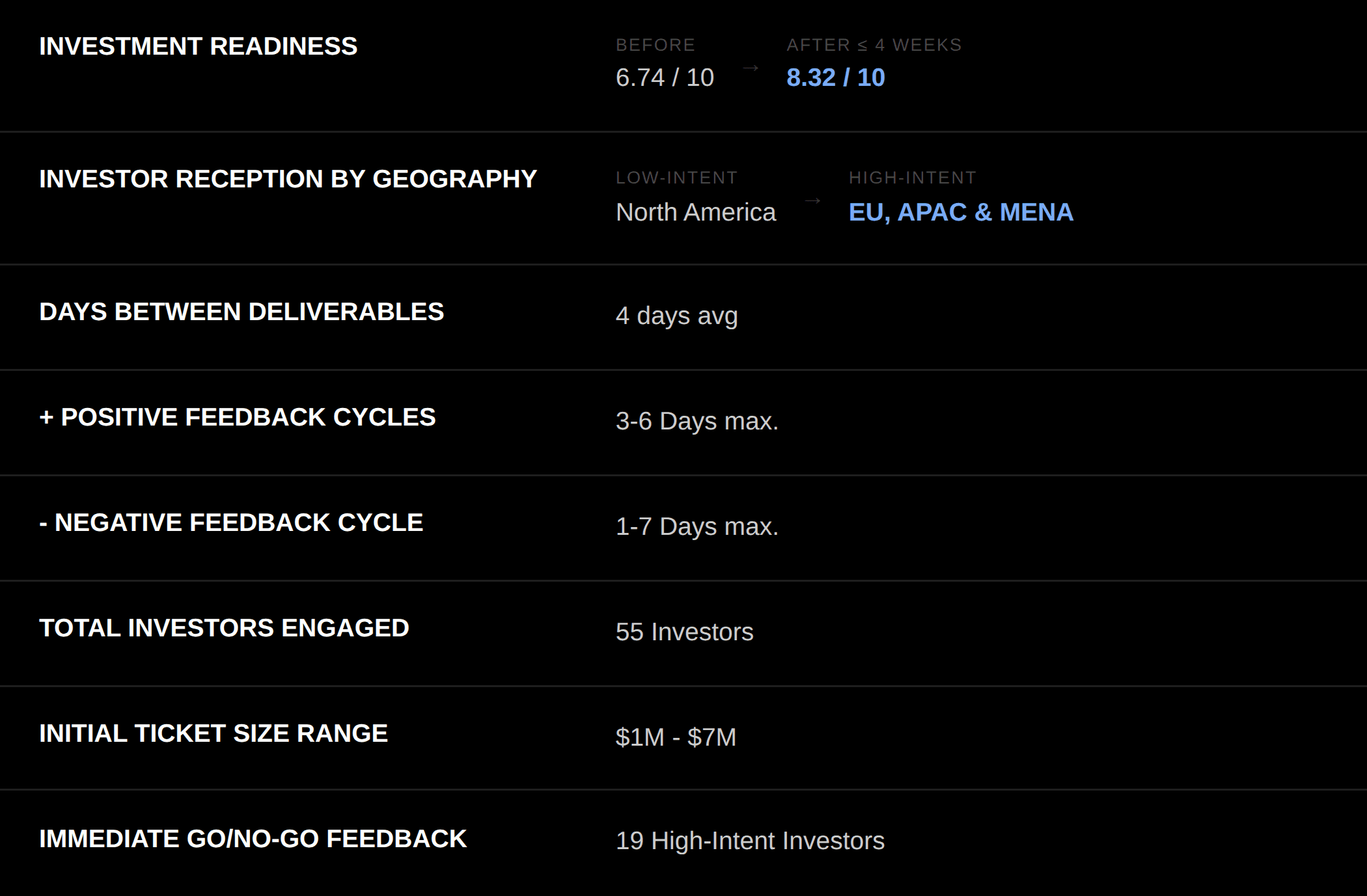
Following the engagement, active funder conversations were generated with over 55 investors across global markets where ticket sizes and criteria aligned with the $3.5M target.
Key Takeaways
Investment readiness is more than a pitch, it proves resilience. In this engagement, the narrative was stress-tested against real market conditions and a significant regulatory shift, demonstrating that proactive planning and institutional-grade preparation are non-negotiable for seed stage capital raising in volatile sectors.
The real gap went beyond surface metrics. Sales scalability friction and an execution visibility gap were exposed, revealing that NRR, CAC, payback periods, and profitability timelines are the exact metrics institutional investors use to determine whether a SaaS product is essential infrastructure or a one-off pilot.
Addressing those gaps required a sequenced approach: a proprietary investment readiness assessment uncovered weaknesses in narrative, financial models, and sales processes; the strategic narrative was professionalized with milestone-linked use of funds and high-impact metrics; and a documented GTM strategy with defined Ideal Customer Profiles improved the loss-to-win ratio and demonstrated execution credibility.
The engagement sprint for the capital-raise engaged over 55 investors, moving from cold outreach to meetings with leading GPs and VCs, supported by an audit-ready data room built to streamline due diligence and demonstrate institutional readiness. Insights from this engagement prompted leadership to redirect the climate tech funding strategy toward EU, MENA, and select APAC markets, where investor sentiment for early-stage climate tech remained stronger post-OBBBA. Despite driving up to three investor conversations per week and generating high-value feedback amid macroeconomic headwinds, no capital raise was ultimately executed due to sudden, top-down, policy-driven structural shifts across the global investor landscape.